4-Week Fit-at-Home Plan: Minimal Equipment, Daily Stretch
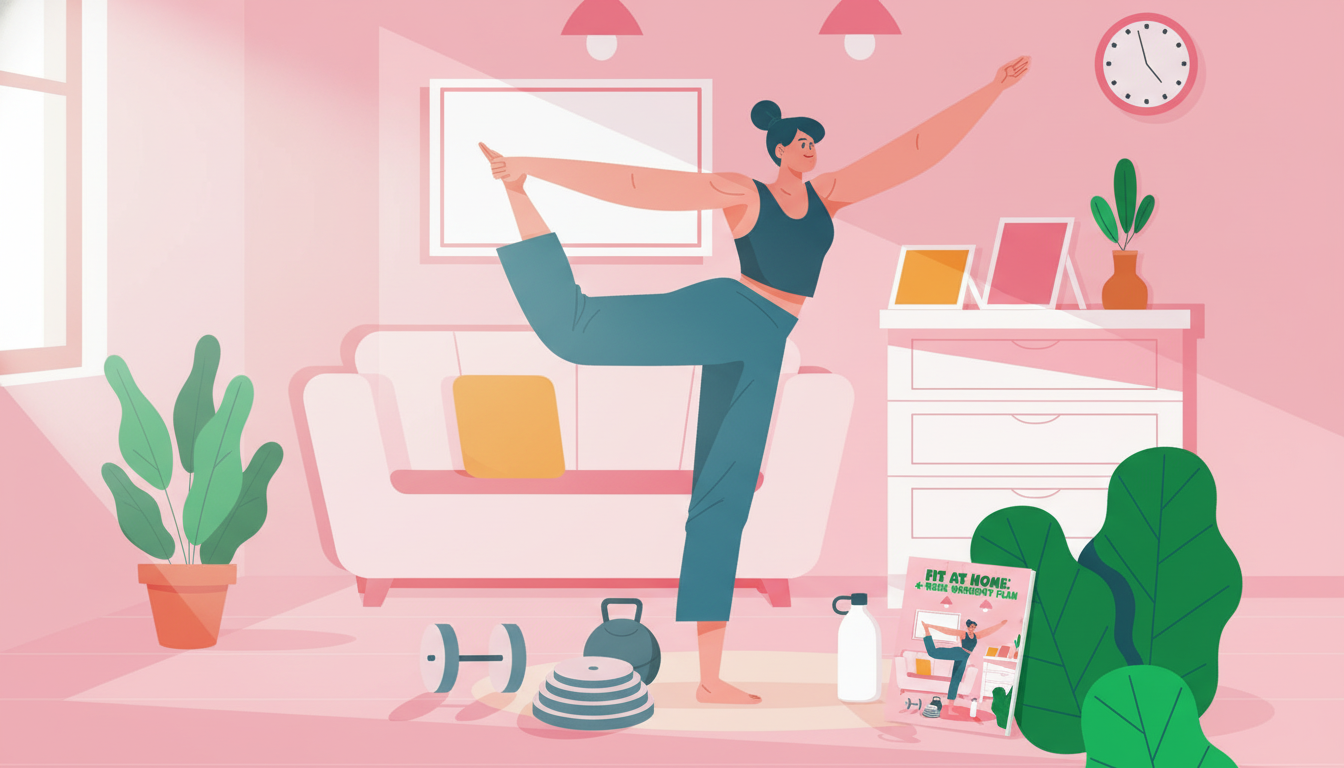
A consistent plan beats random workouts—especially at home. This 4-week schedule uses minimal equipment, short warm-ups, simple strength circuits, and daily stretching to build momentum without needing a full gym setup. The structure makes it easy to follow day-by-day, track progress, and adjust intensity based on fitness level.
What This 4-Week Plan Is Designed to Do
- Build a repeatable weekly rhythm: strength, conditioning, mobility, and recovery
- Support full-body fitness with minimal equipment and limited space
- Use progressive overload through reps, tempo, rest time, and exercise variations
- Include daily stretches to reduce stiffness and improve movement quality
- Offer clear options for beginners (easier) and experienced trainees (harder)
If you’re aiming to meet general activity targets (and feel better day to day), this style of plan pairs well with major health recommendations from the Physical Activity Guidelines for Americans and the World Health Organization.
Minimal Equipment and Setup (Keep It Simple)
You can do this with bodyweight alone, but a few basics make progression easier: one light-to-moderate pair of dumbbells, a resistance band, and an exercise mat. If you don’t have those, household items work surprisingly well (backpack with books for weight, a towel for sliders, and a sturdy chair for step-ups or incline push-ups).
Quick space check: you should be able to lie down, extend arms overhead, and take two steps in any direction. For safety, clear clutter, keep water nearby, and use stable footwear—or go barefoot on non-slip flooring.
Minimal-Equipment Substitutions
| Movement Need | Standard Option | At-Home Alternative |
|---|---|---|
| Added resistance | Dumbbells | Backpack, water jugs |
| Pulling / rows | Band row | Towel row around a pole/door anchor (securely), backpack row |
| Core stability | Mat | Carpet or folded towel |
| Cardio intervals | Jump rope | High knees, marching, step-ups |
Weekly Rhythm (Repeat for 4 Weeks)
Repeat the same weekly structure for four weeks. Familiarity is a feature: it helps you improve technique and notice progress without constantly “starting over” with new routines.
- Day 1: Full-body strength + short finisher
- Day 2: Low-impact conditioning + mobility
- Day 3: Lower-body focus + core
- Day 4: Active recovery (walk + stretch) or full rest
- Day 5: Upper-body focus + core
- Day 6: Full-body circuit (moderate intensity) + longer stretch
- Day 7: Reset day (gentle movement, light stretching, plan the next week)
Sample Week at a Glance
| Day | Focus | Time |
|---|---|---|
| Mon | Full-body strength | 25–40 min |
| Tue | Conditioning + mobility | 20–35 min |
| Wed | Lower body + core | 25–40 min |
| Thu | Active recovery or rest | 15–30 min |
| Fri | Upper body + core | 25–40 min |
| Sat | Full-body circuit + stretch | 30–45 min |
| Sun | Reset + gentle stretch | 10–25 min |
Daily Workout Format (So It’s Easy to Follow)
Each training day follows the same template so you can focus on execution rather than decision fatigue.
- Warm-up (4–6 minutes): joint circles, hip hinges, bodyweight squats, shoulder openers, light marching
- Main block (15–25 minutes): 2–4 sets of 3–6 movements, controlled tempo, steady form
- Finisher (optional, 3–8 minutes): short intervals for conditioning or core
- Daily stretch (5–10 minutes): hips, hamstrings, calves, chest/shoulders, gentle spinal rotation
- Effort guide: stop 1–2 reps before form breaks; build intensity gradually across the weeks
A simple way to stay consistent is to set a repeating timer for intervals and rest periods. If your phone battery is always on the edge during workouts, a small travel charger can help keep your setup reliable: 10W Dual USB Fast Charger Adapter for Smartphones & Travel Use.
Progression Across 4 Weeks (Without Overcomplicating It)
You don’t need a complicated program to progress at home. Pick one “lever” each week—reps, sets, tempo, rest, or a harder variation—and keep everything else stable.
- Week 1: learn the movements, moderate effort, longer rest (60–90 seconds)
- Week 2: add 1 set to main lifts or add 2–4 reps per set; rest 45–75 seconds
- Week 3: add tempo (3 seconds down, 1 second up) or harder variations; rest 45–60 seconds
- Week 4: slightly higher density (same work, less rest) while keeping form strict; include a lighter recovery day if needed
- Simple tracking: record sets/reps, perceived effort, and any discomfort to guide adjustments
For strength training fundamentals and why progressive overload matters, the American College of Sports Medicine is a solid reference point: ACSM: Resistance Training for Health and Fitness.
Daily Stretches That Pair Well With Home Workouts
Common Mistakes That Stall Results (And Quick Fixes)
Recovery is also easier when meals are simple and comforting. For a quick, printable idea list you can keep on your phone or fridge, consider The Ultimate Winter Warm-Meals Checklist (Printable).
Printable Plan Option (PDF eBook)
A structured 4-week schedule can be easier to follow than piecing together random videos—especially when it includes day-by-day workouts, built-in stretching, and simple progression guidance. If you want a ready-to-use format for consistency and tracking, see: Fit at Home: 4-Week Workout Plan | Minimal Equipment Exercise Guide PDF | Home Fitness eBook with Daily Workouts & Stretches.
FAQ
How long should each daily workout take?
Most days take about 20–45 minutes including a short warm-up, the main block, and a quick stretch. To shorten, reduce the number of rounds/sets, pick fewer exercises, and keep the finisher optional.
Can beginners follow a 4-week home workout plan with minimal equipment?
Yes—beginners can use easier options like incline push-ups, smaller ranges of motion, and fewer sets while keeping form strict. Keep effort at a level where you could still do 1–2 more good reps, and use recovery days as needed.
What if there’s no equipment at all?
Use bodyweight staples like squats, lunges, glute bridges, planks, and push-up variations, and add challenge by increasing reps or slowing the lowering phase. If available, a backpack with books can provide simple added resistance without “gym” equipment.










Leave a comment