How to Ask for Help Without Feeling Weak (Scripts + Steps)

Asking for help can trigger worries about judgment, burdening others, or “not being capable enough.” Yet healthy support-seeking is a skill that strengthens resilience, relationships, and performance. The steps below break down what fuels the discomfort, how to communicate clearly, and what to say in real situations—so help becomes a confident choice rather than a last resort.
Why asking for help feels so hard (and why it’s not weakness)
Many people don’t avoid asking because they lack words—they avoid it because of quiet, persistent beliefs: “I should handle this alone,” “If I ask, I’ll look incompetent,” or “I’m bothering people.” Those thoughts can feel like facts, but they’re usually learned rules that once protected you (from criticism, conflict, or disappointment) and now limit you.
Independence is valuable. The problem starts when independence turns into self-isolation—when “capable” becomes “I must be self-sufficient at all costs.” Capability includes knowing when to collaborate, when to delegate, and when to seek expertise so outcomes improve. Framed that way, asking for help is responsibility: it protects your time, the quality of your work, your mental health, and the people affected by the outcome.
For a research-backed view of how support strengthens resilience, see the American Psychological Association’s overview of resilience.
Spot the real need before you ask
Confident requests start before you contact anyone. First, name the type of help that would actually move things forward. Common categories include: information (you need facts), decision support (a second opinion), emotional support (you need steadiness), hands-on assistance (someone does a task), accountability (check-ins), or resources (tools, templates, introductions).
Next, clarify urgency. “Today,” “this week,” or “whenever you have time” sets expectations and reduces pressure. Finally, define what “done” looks like: a quick review, a 15-minute brainstorm, or one concrete task completed.
Quick self-check before reaching out
| Question | Examples of clear answers |
|---|---|
| What exactly is stuck? | “I can’t decide between option A and B.” |
| What kind of help would move this forward? | “I need a 10-minute sanity check.” |
| What is the deadline? | “I need to send it by Friday at noon.” |
| What have you tried already? | “I drafted a plan and outlined risks.” |
| What is a reasonable ask? | “Could you review one page, not the whole document?” |
Choose the right person and the right channel
When requests go poorly, it’s often a mismatch—not a personal failure. Match the helper to the need: expertise for technical problems, empathy for emotional strain, authority for approvals, and peers for collaboration. Also match the channel to the complexity. A message works for simple clarifications; a call is better for nuance; a short meeting is best for decisions that require alignment.
Respect constraints upfront: time zones, workload cycles, and personal boundaries. Asking “Do you have bandwidth?” is not weakness—it’s social skill. If you’re unsure, make your first outreach a low-pressure check-in rather than a full ask.
A simple script that sounds confident
A reliable structure keeps you from overexplaining or apologizing: context + specific request + time needed + deadline + appreciation + easy out. Use “I” statements without self-judgment. Instead of “Sorry to bother you,” try “I’d value your input.”
Copy-and-use request templates
| Situation | Template you can adapt |
|---|---|
| Work: quick expertise | “Could you take 10 minutes to check whether my approach to [topic] makes sense? I’m aiming to finalize by [deadline]. If now isn’t a good time, no worries—another suggestion is welcome.” |
| Friend/partner: emotional support | “I’m feeling overwhelmed and could use a listening ear. Do you have the bandwidth for a 15-minute call tonight or tomorrow?” |
| Family: practical help | “I need help with [task] this week. Would you be able to handle [specific part] on [day/time]? If not, could you help me think of another option?” |
| Health: professional support | “I’m noticing [symptoms/concerns] and it’s affecting [sleep/work/mood]. I’d like guidance on next steps and what to monitor.” |
Handle the inner critic in the moment
If stress is affecting your daily functioning, the National Institute of Mental Health guidance on caring for your mental health is a helpful starting point.
If the answer is no: stay grounded and keep moving
Make support-seeking a habit (without over-relying on others)
A guided resource for practicing the skill
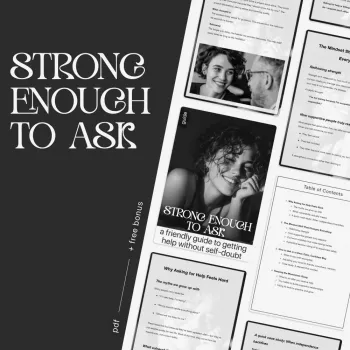
If you want a repeatable way to rehearse scripts, pick the right person, and reduce the emotional load of reaching out, Strong Enough to Ask – A Practical Guide on How to Ask for Help Without Feeling Weak (Digital Download) walks you through a simple process: identify the need, shape a clear ask, send it with confidence, and reflect so each attempt gets easier.
And for everyday follow-through—especially when help involves calls, video chats, or coordinating plans—keeping your devices reliably powered can remove a surprising point of friction. A practical add-on is the 10W Dual USB Fast Charger Adapter for Smartphones & Travel Use, so you’re not avoiding outreach because your phone is at 3%.
FAQ
How do you ask for help without sounding incompetent?
Make the request specific, mention what you’ve already tried, and put a clear time boundary around it (like “10 minutes to review one section”). Skip excessive apologizing and add an easy out so the other person can decline without awkwardness.
What if asking for help makes you feel like a burden?
Ask for consent first (“Do you have bandwidth?”) and keep the request proportionate to your relationship and the situation. Many people feel valued when they’re trusted for support, especially when the ask is clear and respectful.
How do you ask for emotional support when you don’t know what you need?
Start with the simplest version: “Can you listen for 10 minutes?” or “Can you help me sort my thoughts?” Once you feel calmer, you can decide whether you want advice, reassurance, problem-solving, or just companionship.










Leave a comment