Career Compass eBook: 30-Day Plan for Smart Growth

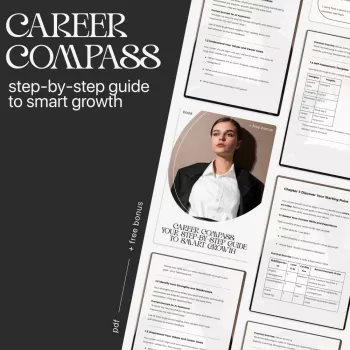
Career Compass: A Step-by-Step System for Goal Setting, Skill Building, and Professional Growth
Career growth tends to stall when goals are vague, skills are picked at random, and progress isn’t tracked. Career Compass is a digital eBook designed to turn career development into a clear sequence of decisions: define direction, choose high-leverage skills, build a realistic plan, and measure results—without overcomplicating the process.
When the next step feels fuzzy, a simple structure can create momentum. Instead of chasing another credential “just in case,” the goal is to build proof: outcomes, deliverables, and a clear story of impact that stands up in performance conversations and interviews.
What “smart growth” looks like in a real career plan
Smart growth is less about doing more and more about doing what compounds. It starts with clarity and ends with evidence.
- Clarity first: identify what “better” means (role, level, industry, work style, compensation, impact).
- Focus on controllables: skill acquisition, portfolio outputs, networking habits, interview readiness, and consistent delivery.
- Use a simple feedback loop: plan → act → review → adjust, so progress continues even when priorities change.
- Avoid common traps: chasing credentials without outcomes, over-planning, and saying yes to work that doesn’t compound.
- Build momentum through small wins: weekly deliverables that create evidence of capability (projects, write-ups, metrics).
One practical way to sharpen clarity is to compare your target role to real labor-market expectations. The U.S. Bureau of Labor Statistics Occupational Outlook Handbook and O*NET OnLine are reliable places to validate responsibilities, skills, and typical pathways.
What’s included in Career Compass
Career Compass is built for action: it helps turn long-term ambitions into milestones and weekly commitments, while keeping the focus on outcomes that matter.
- A structured path for goal setting that turns long-term ambitions into milestones and weekly actions.
- Guidance for choosing skills based on outcomes (promotion readiness, role switch, stronger performance reviews).
- Reflection prompts to identify strengths, gaps, constraints, and the most realistic next step.
- Planning pages for prioritizing tasks, tracking progress, and adjusting when life/work gets busy.
- A practical approach for building professional credibility through measurable results and documented wins.
Key components and how they help
| Component | Purpose | Best for |
|---|---|---|
| Career direction prompts | Clarify target roles and success criteria | Feeling stuck or pulled in multiple directions |
| Goal-setting framework | Translate ambitions into deadlines and milestones | People who start strong but lose traction |
| Skill-building plan | Pick skills that map to job requirements and outcomes | Upskilling for a promotion or role change |
| Progress tracking & reviews | Create accountability and course-correct quickly | Maintaining consistency over weeks/months |
| Professional growth checkpoints | Capture wins and prepare for reviews/interviews | Performance conversations and job searches |
A step-by-step method for turning goals into weekly progress
A career plan works when it converts effort into visible outputs. The method below keeps the loop tight: choose, execute, document, adjust.
- Define a target outcome (role scope, responsibilities, and what success looks like in 6–12 months).
- Identify skill gaps by comparing target requirements to current capabilities (tools, communication, leadership, domain knowledge).
- Select 1–3 high-impact skills to focus on at a time to prevent dilution and burnout.
- Convert skills into outputs: projects, case studies, presentations, process improvements, or documented results.
- Add a cadence: weekly actions, a mid-month check, and an end-of-month review to lock in learning.
- Keep proof: measurable outcomes, feedback snippets, and deliverables that support promotions or applications.
If goal setting tends to drift into “someday,” it helps to anchor goals to clear criteria. The SMART goal framework is a useful reference point for making goals specific and trackable (see MindTools on SMART Goals).
Who this eBook fits best (and when it’s the right time to use it)
- Early-career professionals building confidence, direction, and a repeatable growth system.
- Mid-career professionals aiming for promotion readiness: stronger ownership, leadership signals, and performance narratives.
- Career switchers who need a structured plan to close gaps and produce portfolio evidence.
- People returning to work after a break who want to rebuild momentum and focus.
- Anyone overwhelmed by options and looking for a simple system to decide what to learn next and how to follow through.
A practical 30-day way to use Career Compass
This 30-day cycle is designed to create tangible proof fast—without requiring a life overhaul.
Digital download details and how to get started quickly
Recommended picks (in stock)
- Career Compass: Your Step-by-Step Guide to Smart Growth (Digital Download)
- Alviero Martini Prima Classe Women’s Beige Bag with Zip (a polished everyday carry for commuting, meetings, and conferences)
- Dolce & Gabbana Gold Charm Necklace with Carretto Pendants and Crystals (a statement accessory for events and presentations where presence matters)
FAQ
Is this eBook better for a promotion plan or a career change?
It supports both. For promotions, the structure emphasizes scope, impact, and visibility; for career changes, it prioritizes closing gaps, building role-aligned outputs, and creating portfolio-ready proof.
How much time per week is needed to see progress?
A realistic range is about 1–3 hours per week across planning and skill practice, plus focused time to produce outputs. Consistency matters more than intensity, so starting with one skill and one measurable deliverable is usually enough to build momentum.
What if the goal is unclear right now?
Use the prompts to define constraints and preferences first, then run a 30-day experiment to test direction. The review cycles help refine your target based on evidence, instead of waiting for perfect clarity.









Leave a comment