Cordless Pole Saw vs Battery Tree Trimmer: Pick Right
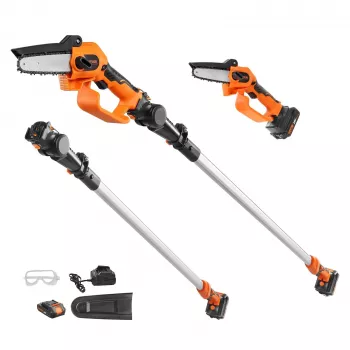
Cordless Pole Saw Chainsaw vs Battery Powered Tree Trimmer: Which Tool Fits the Job?
Cordless cutting tools make it easier to manage branches without gas fumes, extension cords, or repeated pull-starts. The better choice depends on what you’re cutting (thin twigs vs. thicker limbs), where you’re cutting (overhead vs. waist height), and how often you’ll use the tool. Below is a practical breakdown of the differences between a cordless pole saw chainsaw and a battery powered tree trimmer—plus real-world use cases, day-to-day performance factors, and safety essentials.
Quick definitions: what each tool is designed to do
A cordless pole saw chainsaw is essentially a small chainsaw head mounted on an extension pole, built for pruning overhead branches while you stay on the ground. It’s made to trade precision for reach, helping you cut higher limbs without climbing.
A battery powered tree trimmer is a broader label that often refers to handheld pruning tools used closer to the body—compact chainsaws, mini chainsaws, or even powered loppers—where controlled, accurate cuts are the priority.
There’s also plenty of overlap. Many “tree trimmers” still use a chainsaw-style bar and chain; the main differences are reach and cutting posture. If your yard work includes both overhead pruning and close-in trimming, a convertible 2-in-1 setup can cover both tasks without buying two separate tools.
Best use cases by branch size and working position
Overhead limbs (canopy pruning)
A pole saw is typically the safer approach for reachable overhead branches because it keeps both feet on the ground. Instead of balancing on a ladder while pushing a saw outward, you can stand with stable footing, extend the pole, and cut at a safer distance—while still respecting falling-debris hazards.
Thicker branches at shoulder height or below
A handheld mini chainsaw generally offers better control than a long pole when the cut is near chest level or lower. The shorter tool is easier to position for clean, accurate cuts and is less likely to “wander” as the chain bites.
Light, frequent trimming sessions
For quick canopy cleanup, small branch removal, and repeated snips around the yard, a battery trimmer/mini chainsaw reduces fatigue and speeds up stop-and-go trimming. Less setup time usually means it gets used more often—and that can prevent small problems from becoming bigger ones.
Occasional storm cleanup
Pole saws can be helpful for dealing with broken “hangers” or snagged branches without reaching for a ladder. That said, storm-damaged wood is unpredictable; only cut within safe angles, maintain stable footing, and avoid tensioned limbs that could shift suddenly.
Performance differences that matter day-to-day
Reach vs. control
Cutting speed (it’s not just voltage)
Battery runtime under load
Weight distribution and fatigue
Noise and fumes
Side-by-side comparison table
| Feature | Cordless Pole Saw (chainsaw head) | Battery Powered Tree Trimmer / Mini Chainsaw |
|---|---|---|
| Primary strength | Reaches higher branches from the ground | Controlled cuts at close range |
| Typical best for | Pruning overhead limbs, clearing hangers within reach | Limbing, small branch removal, garden and yard trimming |
| User fatigue | Higher (weight at distance, arms raised) | Lower (tool close to body) |
| Precision | Moderate (long lever arm makes fine positioning harder) | High (easier to place the bar exactly) |
| Setup time | More (pole assembly/extension, strap adjustment) | Less (grab-and-go) |
| Safety considerations | Kickback risk plus overhead falling debris; avoid cutting directly above head | Kickback risk closer to body; maintain firm two-hand grip |
| Storage/transport | Longer footprint | Compact and easier to store |
Safety and technique basics for cleaner cuts
Avoid ladder cutting when possible. For overhead pruning, a pole saw is generally a better option than using a chainsaw-style tool from a ladder because it reduces fall risk. For more on chainsaw-style safety practices, review OSHA’s guidance: OSHA – Chainsaw Safety.
For larger limbs, use the three-cut method: an undercut to prevent tearing, a top cut a bit farther out to remove weight, then a final cut just outside the branch collar. This helps reduce bark stripping and supports healthier healing (see consumer-facing pruning resources from the International Society of Arboriculture).
Where a 2-in-1 cordless pole saw + mini chainsaw fits
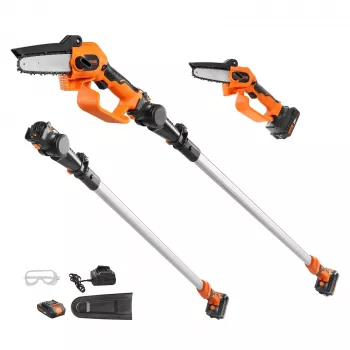
One option to consider is the 2-in-1 Cordless Pole Saw & Mini Chainsaw – 20V Battery Powered Tree Trimmer. When comparing 2-in-1 designs, practical details matter: a secure lock between configurations, comfortable grip geometry, straightforward chain tensioning, and a battery system that fits the length of your typical trimming session.
Maintenance that keeps performance consistent
More in-stock picks from our store
- 2-in-1 Cordless Pole Saw & Mini Chainsaw – 20V Battery Powered Tree Trimmer
- Cactus Cat Tree Tower with Scratching Post & Condo Nest
- Alviero Martini Prima Classe Women’s Beige Bag with Zip
FAQ
Is a pole saw safer than using a mini chainsaw on a ladder?
Generally yes—staying on the ground reduces fall risk and helps you keep stable footing. Even so, avoid cutting directly above your head, keep the drop zone clear, and treat all chainsaw-style tools as kickback-capable equipment.
What size branches can a cordless pole saw or mini chainsaw handle?
Most are best for small-to-medium pruning, and practical limits depend on bar length, chain sharpness, and wood hardness. If you have thick structural limbs or trunk-sized wood, stepping up to a larger saw (or hiring an arborist) is safer than forcing slow, binding cuts.
Do battery powered tree trimmers need bar and chain oil?
If the trimmer uses a bar-and-chain system (like a mini chainsaw or pole saw), it needs lubrication—either via an automatic oiler or manual oiling, depending on the model. Powered loppers or shears are different and don’t use bar-and-chain oil.










Leave a comment