Lower Your Electric Bill: Energy-Saving Checklist
Slash Your Electric Bill: The Ultimate Energy-Saving Checklist
Cutting electric costs gets easier when every change is actionable and measurable. The most reliable approach is to stack “quick wins” that reduce daily waste, then add weekend upgrades that improve efficiency, and finally plan bigger improvements that pay you back in comfort and lower bills. Use the steps below to find your fastest savings first—then track results so the progress sticks.
Start With a 15-Minute Bill and Usage Check
- Compare the last 3–6 months of kWh usage to spot seasonal spikes and unusual jumps.
- Check the price per kWh, delivery charges, and any time-of-use (TOU) rates that change by hour.
- List the biggest electric loads at home: heating/cooling equipment, water heating, laundry, cooking, refrigeration, lighting, and electronics.
- Set a realistic target (example: reduce monthly kWh by 10–20%) and pick 5 actions to start this week.
- If available, enable utility alerts for high-usage days and track progress weekly.
To sanity-check your plan, lean on reputable references like the U.S. Department of Energy Energy Saver and ENERGY STAR home energy tips—then tailor the actions to your home’s biggest loads.
Quick Wins (Today): No-Cost and Low-Cost Habits That Add Up
- Set HVAC fan to “Auto” (not “On”) to avoid constant blower electricity use.
- Adjust thermostat setpoints: slightly warmer in summer, slightly cooler in winter; use sleep/away schedules.
- Turn off lights in empty rooms; prioritize task lighting over whole-room lighting.
- Unplug or switch off idle electronics and chargers; reduce “always-on” standby loads.
- Wash clothes in cold water when possible; run full loads; use high-spin to reduce dryer time.
- Air-dry dishes or shorten heated-dry cycles; skip pre-rinse if dishwasher and detergent allow.
- Lower screen brightness on TVs/monitors and enable power-saving modes on devices.
Plug Loads: Stop Paying for Standby Power
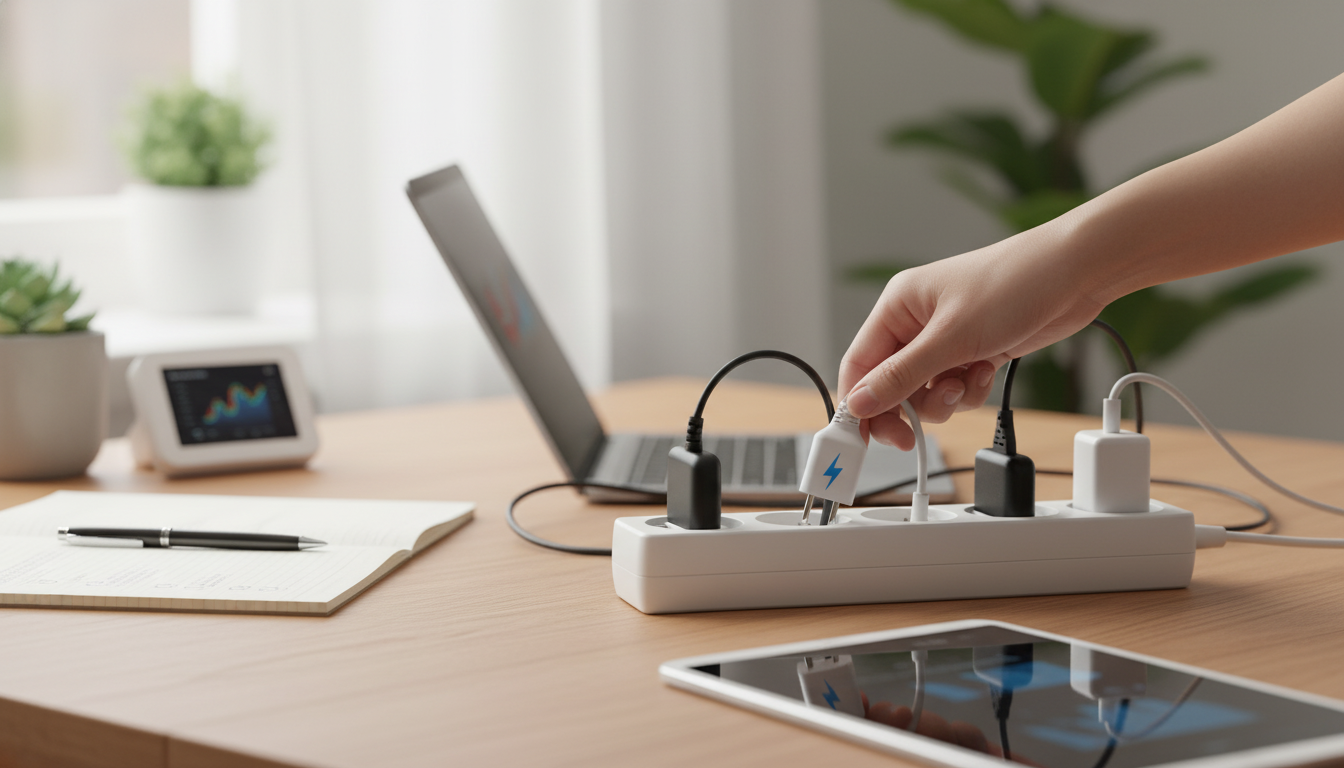
- Group devices into zones (TV console, desk, bedroom) and use a single switch/power strip routine.
- Identify common hidden loads: game consoles, set-top boxes, soundbars, printers, smart speakers, and older chargers.
- Use sleep timers for TVs and streaming devices; disable “instant-on” features where acceptable.
- Charge laptops and phones during planned windows rather than leaving them connected 24/7.
- For homes on TOU plans, shift charging and high-watt tasks to off-peak hours when possible.
A practical setup is to consolidate charging into one spot so you’re not feeding multiple “vampire” chargers all day. A compact adapter like the 10W Dual USB Fast Charger Adapter for Smartphones & Travel Use can help simplify routines—charge during a planned window, then fully unplug or switch off the outlet/strip.
Lighting: Fast Efficiency Gains With Better Bulbs and Smarter Use
- Replace remaining incandescent/halogen bulbs with LEDs, starting with the most-used fixtures.
- Choose the right brightness (lumens) rather than higher wattage; match color temperature to room use.
- Add motion sensors or timers in low-traffic areas (hallways, laundry room, garage).
- Maximize daylight: open blinds strategically, use lighter interior colors, keep fixtures clean.
Lighting Swap Payoff at a Glance
| Fixture type | Typical old bulb (W) | LED replacement (W) | Hours/day | Estimated monthly kWh saved |
|---|---|---|---|---|
| Living room lamp | 60 | 9 | 4 | ≈6.1 |
| Kitchen ceiling (1 bulb) | 75 | 12 | 3 | ≈5.7 |
| Porch light | 60 | 9 | 8 | ≈12.2 |
| Bedroom lamp | 40 | 6 | 2 | ≈2.0 |
If your rate is $0.18/kWh, saving 12.2 kWh/month on a porch light alone is about $2.20/month—often paying back an LED swap quickly while also reducing bulb replacements.
Heating and Cooling: The Biggest Lever for Most Homes
- Replace HVAC filters on schedule; clogged filters increase fan energy and reduce efficiency.
- Seal obvious air leaks: door sweeps, window gaps, attic access, and plumbing penetrations.
- Use ceiling fans correctly: counterclockwise in summer, clockwise at low speed in winter.
- Keep supply and return vents unblocked; clean dust buildup from registers.
- Maintain outdoor condenser clearance and clean coils if accessible and safe to do so.
- Consider a smart thermostat if schedules are inconsistent; focus on consistent setbacks, not extreme swings.
Water Heating and Hot Water Use: Reduce Both Temperature and Demand
Appliances and the Kitchen: Simple Changes With Reliable Savings
Laundry: Cut Dryer Time First
Plan for Bigger Upgrades: Prioritize by Payback and Comfort
Use the Checklist to Stay Consistent (and Track Results)
For a pre-upgrade estimate, a simple watts-to-kWh calculation helps: (watts reduced ÷ 1000) × hours of use = kWh saved. Multiply by your electric rate to estimate monthly dollars. To understand the broader impact of reduced electricity use, the EPA Greenhouse Gas Equivalencies Calculator can translate kWh savings into emissions context.
A Ready-to-Use Energy-Saving Checklist
If you want a single-page version that’s easy to reuse and mark up, grab the Energy-saving checklist download and keep it with your home notes—then review it once a week while your bill changes are still easy to spot.
FAQ
What is the fastest way to lower an electric bill this month?
Start with HVAC setpoints and schedules, eliminate standby power from always-on electronics, and reduce dryer time. These changes hit high-usage categories that recur every day, so you’ll typically see results on the next bill.
Do smart plugs and power strips really save electricity?
They can, if they consistently shut off devices that still draw power while “off.” The savings depend on how many devices you control and how often you fully cut power instead of leaving equipment in standby.
How can savings be estimated before making upgrades?
Estimate kWh saved with (watts reduced ÷ 1000) × hours of use, then multiply by your electricity rate to get monthly dollar savings. For multi-device changes (like a whole TV console), add the watts of each device you’ll actually power down.











Leave a comment