1100W Commercial Meat Bandsaw with Thickness Control
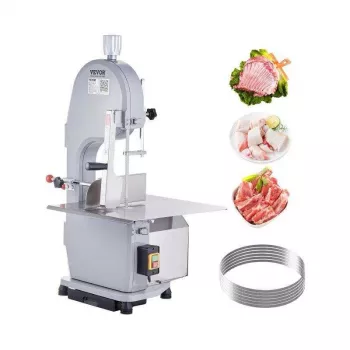
Commercial Electric Meat Bandsaw for Fast, Repeatable Portioning
A commercial meat bandsaw is built for fast, repeatable portioning—whether the goal is uniform steaks, bone-in chops, or neatly sized roasts. This 1100W electric bandsaw adds adjustable cutting thickness to help keep output consistent during busy prep, while reducing waste from uneven slices. When portion sizes stay predictable, packaging looks cleaner, pricing is easier to standardize, and rework from “too thick/too thin” cuts drops dramatically.
What this bandsaw is designed to do
- Portion fresh and partially frozen meat into consistent cuts for display or service
- Handle bone-in cuts more efficiently than a standard slicer (with appropriate blade selection and safe technique)
- Support repeatable thickness settings for standardized portions and cost control
- Fit typical back-of-house workflows: receiving, breakdown, portioning, and packaging
Compared with hand-sawing and repeated knife work, a commercial-style bandsaw format helps keep the cut line straight and the pace steady—especially when the goal is to run multiple pieces to the same spec without stopping to measure each cut.
Key features that matter in daily prep
- 1100W motor power for steady cutting through dense cuts when feed rate is kept consistent
- Adjustable cutting thickness to set a target slice width and repeat it across multiple pieces
- Commercial-style bandsaw format for quicker throughput compared with hand-sawing
- Cleaner portioning workflow where straight, uniform cuts improve presentation and reduce trimming
Specs at a glance
| Item | Details |
|---|---|
| Product | Commercial Electric Meat Bandsaw |
| Power | 1100W |
| Cut thickness control | Adjustable |
| Category use | Commercial portioning and prep |
| Availability | In stock |
How adjustable cutting thickness helps consistency
Adjustable thickness is the difference between “roughly close” and truly standardized portions. Once a target is set, the saw can repeat it across multiple pieces with fewer interruptions—useful for pricing consistency, portion control, and uniform cook times.
- Set thickness for common portions (thin chops vs. thicker steaks) and keep output uniform across batches
- Improve yield by reducing the number of cuts that need rework or trimming
- Speed up repetitive tasks by minimizing measuring and marking between cuts
- Best practice: verify the first cut with a ruler or scale, then lock in the setting before running volume
Example thickness ranges and common uses
| Thickness goal | Typical use | Tips for cleaner results |
|---|---|---|
| Thin | Portioning cutlets or thin chops | Use steady feed pressure; avoid forcing the blade |
| Medium | Standard steaks and chops | Square the product face before portioning for repeatability |
| Thick | Roasts or large bone-in portions | Slow the feed rate; keep hands clear and use push tools as designed |
Performance considerations for meat and bone
Cut quality is a balance of power, blade condition, and technique. Even with a strong motor, the operator’s feed rate and the blade’s sharpness are often the deciding factors for straight, clean results.
- Feed rate matters as much as motor power—pushing too hard can cause wandering cuts and faster blade wear
- Blade choice and sharpness strongly affect cut quality, especially on bone-in items
- Partially frozen product benefits from consistency—keep temperature and firmness stable to reduce crumbling and uneven surfaces
- If the cut starts to drift, stop and check blade tension/alignment (per the manufacturer instructions)
For bone-in work, a slow, controlled feed reduces chatter and helps the blade track correctly. When the product is very dense or irregular, taking an extra moment to square the leading face can improve repeatability across the entire batch.
Setup and safe operation basics
Powered cutting equipment belongs in a controlled station with clear procedures. Always follow the manufacturer’s manual and workplace safety rules.
- Place the saw on a stable, level surface with adequate clearance around the cutting area
- Confirm guards and safety components are correctly installed and functioning before powering on
- Use the thickness setting as a guide; keep hands out of the line of cut and use push tools where appropriate
- Wear appropriate PPE and follow shop safety rules for powered cutting equipment
- Disconnect power before adjustments, blade changes, or cleaning
For additional safety guidance, review OSHA’s meat and poultry processing resources at OSHA – Meat and Poultry Processing: Safety and Health Topics.
Cleaning, sanitation, and maintenance routines
Sanitation keeps the workspace compliant; maintenance keeps cuts straight. Prompt cleaning also prevents residue buildup that can interfere with tracking, guides, and cut accuracy over time.
For food-handling best practices and sanitation references, consult USDA FSIS – Food Safety Information and the FDA – Food Code.
Simple maintenance checklist
| Task | How often | What to look for |
|---|---|---|
| Wipe down and sanitize contact areas | After each session | No residue at guides, table, and guards |
| Blade inspection | Daily/weekly depending on volume | Dullness, damage, uneven cutting |
| Tracking/tension check | As needed | Blade runs centered; cuts remain straight |
| General fastener check | Monthly or per usage | Vibration, looseness, unusual noise |
Troubleshooting common cut-quality issues
Who this bandsaw fits best
In-stock picks
- Commercial Electric Meat Bandsaw 1100W with Adjustable Cutting Thickness
- Cactus Cat Tree Tower with Scratching Post & Condo Nest
- Alviero Martini Prima Classe Women’s Beige Bag with Zip
FAQ
Can this type of bandsaw cut bone-in meat?
Yes. Bandsaws are commonly used for bone-in cuts, but results depend heavily on using the right blade, maintaining sharpness, and feeding slowly while following the manufacturer guidance and workplace safety procedures.
How is cutting thickness adjusted and kept consistent?
Set the target width using the thickness adjustment mechanism, verify it with the first cut, then keep the product face squared and your feed pressure steady. Re-check the setting if the saw is bumped or the product firmness changes.
What maintenance has the biggest impact on straight, clean cuts?
Blade condition and correct tension/tracking have the biggest impact, along with clean guides. Dull blades and residue buildup are common causes of drift, rough surfaces, and tearing.










Leave a comment