AI Public Speaking Practice: 15-Minute Loop for Confidence
AI-Powered Public Speaking Practice for Confident Communication
Confident speaking is built through repetition, clear feedback, and steady exposure to real-world pressure. AI practice tools can speed up that cycle by helping refine structure, wording, pacing, and delivery—without needing a live audience every time. With the right routine, short sessions add up quickly: you’ll know what to fix, what to keep, and how to measure progress week to week.
For broader speaking fundamentals and evaluation tips, Toastmasters offers a solid library of guidance (Toastmasters International — Public Speaking Tips). For stress and body responses that can show up before a talk, the APA overview is also helpful (APA — Stress effects on the body).
What AI Can Improve in Speech Practice
Used well, AI acts like a fast, consistent practice partner: it helps you shape ideas, tighten language, and rehearse under “light pressure” by recording and reviewing. Here are the most useful areas where AI can accelerate improvement:
- Idea-to-outline support: turn a topic into a clear opening, main points, transitions, and close.
- Clarity and concision: simplify long sentences, remove filler, and tighten phrasing without losing meaning.
- Audience fit: adjust tone and examples for a classroom, interview panel, team update, or keynote.
- Delivery coaching: spot rushed pacing, low energy, unclear articulation, and overused filler words during rehearsals.
- Q&A readiness: generate likely questions, objections, and follow-ups, then rehearse responses.
The biggest advantage is speed: instead of guessing what to refine, you can run quick iterations and focus on the changes that actually move your delivery forward.
A Simple AI-Assisted Practice Loop (15–30 Minutes)
Consistency beats marathon sessions. A short loop—done several times across a week—creates steady gains without overwhelming you. Use the steps below, and keep each round focused on one change only.
Practice Loop Checklist
| Step | Goal | Quick indicator |
|---|---|---|
| 1. One-sentence message | Clarify purpose | Can be repeated verbatim without stumbling |
| 2. Outline | Create structure | Each point supports the message |
| 3. Clarity edit | Reduce cognitive load | Fewer long sentences and fewer qualifiers |
| 4. Record rehearsal | Capture delivery data | Audio is clear; face and gestures visible if video |
| 5. One change only | Improve fast | A single focus area chosen (pace, pauses, filler, transitions) |
| 6. Re-record | Lock in improvement | Noticeable difference vs. Take 1 |
To make this loop even more effective, keep a single running note with: date, talk title, time limit, your “one change,” and a one-line reflection like “Paused after each main point; felt calmer and clearer.” That turns practice into a trackable training log instead of a vague memory.
How to Use AI Without Sounding Scripted
AI can help generate clean language, but a speech still needs to feel human—especially in interviews, team updates, and any situation where credibility matters. The goal is “prepared,” not “programmed.”
- Aim for spoken language phrasing: shorter sentences, natural transitions, and occasional intentional repetition.
- Keep a flexible outline, not a full script: speak from bullet points, not paragraphs.
- Mark pause points: add beats after key claims, before numbers, and after a story punchline.
- Add one authentic detail per main point: a brief anecdote, specific example, or short case.
- Practice with constraint rounds: one run with no notes, one run with only headings, one run with a timed limit.
A useful test is this: if you lose your place, can you smoothly restate the idea in different words and continue? If yes, you’re speaking—not reciting.
Common Speaking Challenges and Fast Fixes
Most speaking issues are pattern-based, which means they’re fixable with a small, repeatable adjustment. Pick one challenge per session so improvements “stick.”
A Digital Practice Guide to Keep Sessions Consistent
For anxiety that feels intense or persistent, it may help to learn more about social anxiety and supports from a trusted health source (NHS — Social anxiety disorder (social phobia)).
Recommended Resources (In Stock)
Speech Practice eBook (Digital Download)
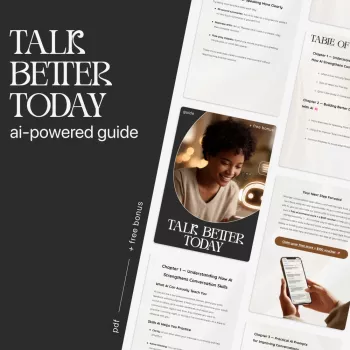
If you want a structured routine you can repeat quickly, the Speech Practice eBook (digital download) for confident communication is designed to pair well with AI-assisted drafting and record-and-review rehearsal. It’s especially handy for students, professionals, interview prep, presentations, and everyday speaking situations.
Professional Presentation Add-Ons
- Alviero Martini Prima Classe Women’s Beige Bag with Zip (in stock): a polished, work-ready option for interviews, conferences, and client meetings.
- Dolce & Gabbana Gold Charm Necklace with Carretto Pendants and Crystals (in stock): a statement accessory for formal events and on-stage appearances.
Product Snapshot
| Item | Details |
|---|---|
| Title | AI Tools for Public Speaking Practice | Public Speaking Guide | Speech Practice eBook | Digital Download for Confident Communication |
| Format | Digital download (eBook) |
| Price | $7.99 USD |
| Availability | In stock |
FAQ
Can AI help with public speaking anxiety?
AI can help by making practice frequent, low-stakes, and repeatable—especially with timed runs and recorded rehearsals that reduce uncertainty over time. Planning pauses and breathing points, then gradually increasing difficulty (short talk, longer talk, simulated Q&A) builds comfort. It’s a practice aid, not a medical treatment.
How often should a speech be practiced to feel confident?
Three to five focused sessions is a practical baseline, with short daily runs (15–30 minutes) working well for most schedules. Keep one improvement target per session, then do one final full run under realistic conditions (time limit, standing, recorded) before the real event.
Is it better to memorize a speech or use notes?
Memorizing the opening, closing, and key transitions usually creates the best balance of confidence and natural delivery. Use a bullet outline for the body so you can stay connected to the audience instead of sounding robotic or panicking if a memorized line slips.








Leave a comment