Daily Self-Belief Checklist: Build Confidence in 10 Minutes
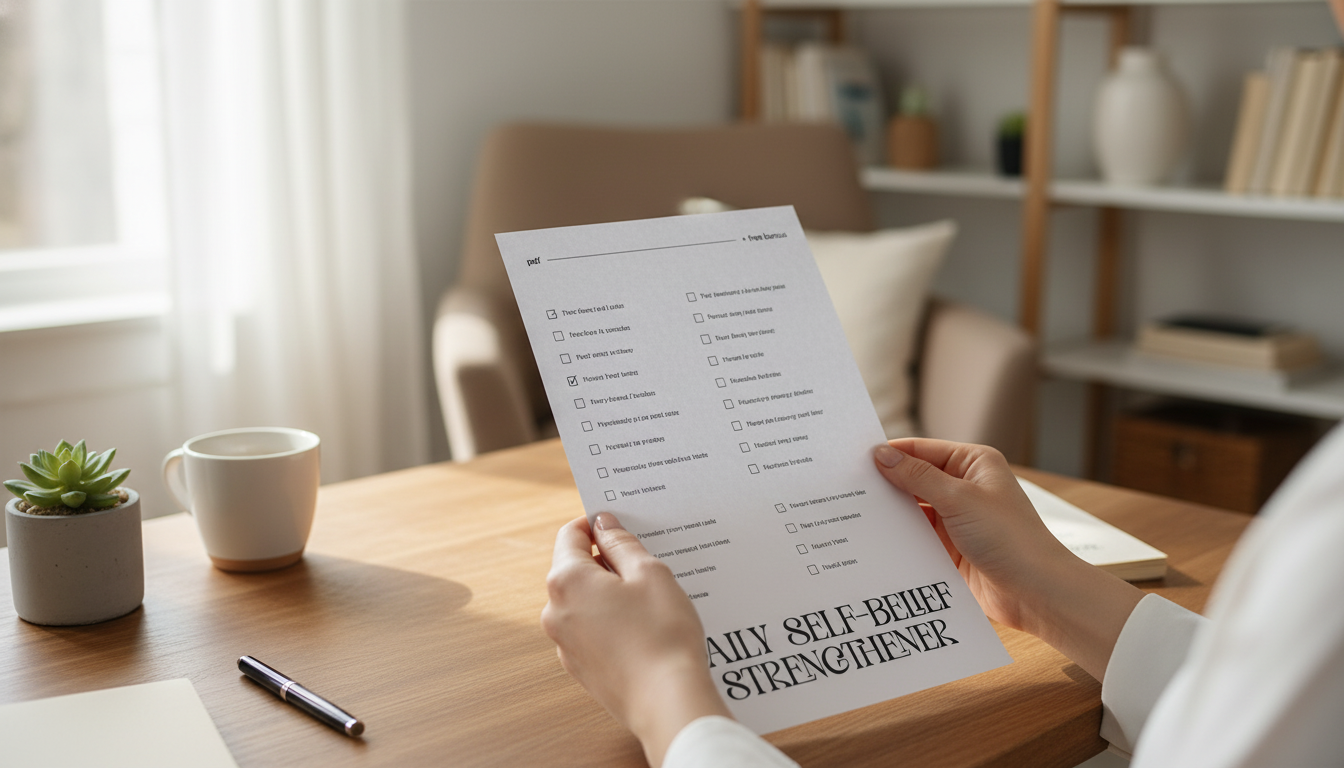
The Daily Self-Belief Strengthener: A Simple Checklist to Build Confidence Every Day
Self-belief grows fastest when it’s practiced in small, repeatable ways. A daily checklist turns confidence-building into a routine: clear cues, quick wins, and a consistent way to challenge doubt without needing perfect motivation. The goal isn’t to “feel confident” 24/7—it’s to build reliable evidence that you can follow through, recover, and keep going.
Below is a practical breakdown of what self-belief looks like day to day, why checklists work when motivation dips, and how to use a printable routine that takes 5–10 minutes.
What “self-belief” looks like in daily life
Self-belief is less about hype and more about trust: trust that you can take action, handle discomfort, and come back from mistakes. Here are common, real-life signs it’s getting stronger:
- Choosing action before certainty: taking one step even while feeling nervous.
- Trusting follow-through: doing what was planned more often than not (even if it’s smaller than originally imagined).
- Recovering quickly: bouncing back after mistakes without spiraling into harsh self-criticism.
- Setting boundaries: protecting time and energy instead of defaulting to people-pleasing.
- Using evidence: noticing proof of progress rather than only gaps.
Psychology often frames this as self-efficacy: confidence in your ability to carry out actions and influence outcomes. A daily checklist helps you collect that evidence in small, steady doses.
Why a checklist works when motivation doesn’t
Motivation can be unreliable—especially during busy seasons, anxiety spikes, or low-energy weeks. A checklist reduces the need to “figure it out” every day and replaces it with a simple script.
- Reduces decision fatigue: turns “What should I do?” into a short sequence.
- Builds identity through consistency: repeated actions create a stronger self-story (“I’m someone who follows through”).
- Creates visible momentum: checking boxes reinforces capability and progress.
- Makes confidence measurable: highlights patterns, not just feelings.
- Supports nervous-system regulation: brief grounding steps reduce threat response and make action feel safer.
It also helps with recurring negative “automatic thoughts” (those quick, reflexive interpretations that skew pessimistic). Naming the thought and responding with one workable action can break the loop. The APA definition is helpful context: Automatic Thoughts.
The Daily Self-Belief Strengthener: what’s included and how to use it
If you want an easy, structured tool, The Daily Self-Belief Strengthener printable checklist is designed as a quick daily practice for confidence and mindset.
- Printable daily checklist built for self-belief, follow-through, and realistic progress.
- Best used as a 5–10 minute routine: a short morning setup plus an evening reflection.
- Pen-and-paper friendly: writing by hand often improves recall and commitment.
- Flexible tracking: use one sheet per day or repeat the same sheet weekly to spot trends.
- Pairs best with one small goal at a time: keep wins realistic to avoid overwhelm.
A simple daily flow (example)
| Time | What to do | Goal |
|---|---|---|
| Morning (2–3 min) | Choose one priority and one tiny “proof” action | Create a doable win |
| Midday (1 min) | Quick check-in: posture/breath + one supportive thought | Reset momentum |
| Evening (3–5 min) | Mark completed actions + note one lesson and one win | Lock in evidence |
To make the routine easier to stick with, consider pairing your checklist with simple support tools you already use daily. For example, keeping a reliable charger in a consistent spot can reinforce the habit of setting reminders or doing a quick midday check-in: 10W Dual USB Fast Charger Adapter for Smartphones & Travel Use.
Daily checklist prompts that strengthen self-belief
Strong self-belief comes from specific behaviors you can point to. These prompts keep the practice grounded, not cheesy:
- One promise kept today: choose a small commitment and complete it (reply to an email, 10-minute tidy, short walk).
- One discomfort practiced: do a manageable hard thing (ask a question, share a draft, make the call).
- One thought reframe: replace an absolute (“I can’t”) with a workable next step (“I can try for 10 minutes”).
- One boundary honored: say no, delay, delegate, or reduce scope.
- One piece of evidence: write a concrete example of progress (what improved, what was learned, what was handled).
- One self-respect action: sleep plan, hydration, movement, or tidying your space.
If you want an extra boost in the “regulation” category, a tiny mindfulness moment can help you respond instead of react. The National Center for Complementary and Integrative Health offers a clear overview of mindfulness and how brief practices can support stress management.
Common sticking points (and quick fixes)
How to make the routine last beyond the first week
For a ready-to-print structure that keeps everything in one place, use The Daily Self-Belief Strengthener | Confidence & Mindset Printable Checklist as your daily “evidence collector.”
FAQ
How long does it take to notice stronger self-belief with a daily checklist?
Small shifts often show up within 1–2 weeks as follow-through improves and you start collecting daily wins. Deeper confidence typically builds over 4–8 weeks of repeated evidence, especially when you track actions instead of waiting to “feel confident.”
What if negative self-talk keeps coming back?
Recurring thoughts are normal; the goal is changing your response, not eliminating thoughts entirely. Use a quick reframe plus one line of counter-evidence, then take a small action that contradicts the thought.
Can this work for anxiety or burnout days?
Yes—use a minimum version: complete 1–2 checkboxes only, plus one regulation step (slow breathing, a short walk, or hydration). Choose actions that reduce load while still keeping one small promise.











Leave a comment